The console is usually not broken and the plan is usually fine. A PS5 sits still, sits low, and often sits on 2.4 GHz — and each of those costs you more than you would think.
How this page is funded: some links here are affiliate links, and Mesh & Signal earns a commission if you buy through them. It costs you nothing extra, it never changes which product we rank first, and we do not publish a price we have not verified. Full disclosure.
A PS5 is usually slow on Wi-Fi because it has joined the 2.4 GHz band, sits low down in an entertainment unit behind a TV, and never moves to a better spot the way a phone does. Check the band first — it is free and it is the answer surprisingly often.
Check the band before anything else
On the console, open Settings → Network → Connection Status and look at the connection speed and the frequency band. If it says 2.4 GHz, that is your answer: 2.4 GHz is slower, far more congested, and shared with every microwave, Bluetooth device and neighbor on the street.
Fixing it depends on your router. If your 5 GHz and 2.4 GHz radios share one network name, the console chose badly and will keep choosing badly, because it never moves and never re-evaluates. Splitting the bands into two network names and joining the PS5 to the 5 GHz one is the cleanest fix. If your router does not offer that, moving the console or the router so the 5 GHz signal is clearly stronger will usually make the console pick it.
Why a console is worse off than your phone
Your phone
A PS5
Position
Moves to wherever you are
Fixed, usually low and enclosed
Antenna
Re-oriented constantly as you hold it
One orientation, forever
Surroundings
Open air
Inside a cabinet, behind a TV, beside a soundbar
Band choice
Re-evaluated every time it reconnects
Chosen once and kept
What it is doing
Short bursts
Sustained multi-gigabyte downloads
Same network, different outcome.
Scroll the table sideways to see every column.
That last row matters more than people expect. A phone speed test is a ten-second burst; a 90 GB game download is twenty minutes of sustained throughput during which every dropped packet gets retransmitted. A link that looks fine on a speed test can still crawl on a download.
The free checks, in order
Band. As above. 5 GHz if the router is in range, 2.4 GHz only if it genuinely is not.
Line of sight. Pull the console forward in the cabinet, or out of it. A metal-backed entertainment unit is a shield.
Test at a different time. If evenings are bad and mornings are fine, this is congestion rather than the console — Wi-Fi slow at night.
Compare against a phone in the same spot. Hold a phone next to the console and run a speed test. If the phone is also slow there, the problem is coverage and not the PS5 — test Wi-Fi speed in each room.
Pause other downloads and check nothing else in the house is saturating the connection.
Try this first
Wire it. It is a console, not a phone.
The PS5 is never going to move. That makes it the single best candidate in the house for a wired link — and a wire fixes download speed, lag spikes, and the matchmaking problems that come from packet loss, all at once. If an Ethernet run is impossible, coax or mains wiring will do it. This is the fix that does not come back.
If it only happens when downloading
Sony's own download speeds vary with their content delivery network and the time of day, so a slow download with a fast speed test is not always a network fault. Two things worth trying: pause and resume the download, which sometimes lands you on a different server, and put the console in rest mode with downloads allowed, which stops the system sharing bandwidth with a running game.
If it only happens online in games
Then the problem is latency and packet loss rather than speed, and raw throughput will not tell you about it. That is a different page: Wi-Fi for gaming in an apartment and best Wi-Fi extenders for gaming both deal with the jitter problem, and the answer in both is the same wire recommended above.
And if every device in the house is slow rather than just the console, start at why is my Wi-Fi so slow instead — this page is for the case where the PS5 is the outlier.
How we picked
We do not run a test lab. Rankings here are built from the manufacturers' published specifications, measurements taken by independent outlets that do have labs, and the structural reasoning on this site about what a given house or job actually needs. Every product was checked as currently sold before it was included. Where a figure appears it is attributed and linked in Sources; where we have no basis for a claim, it is left out. Our methodology sets out exactly what we will and will not assert.
Quick picks
Ranked by our published scoring rubric (speed gained, latency, install effort, value). Tap any row to jump to the full write-up, or go straight to the retailer from the right-hand column. How we score.
#
Product
Best for
Score
Price
1
ScreenBeam ECB6200K02Bonded MoCA 2.0 with a ceiling around 1 Gbps — above almost every household plan — over the TV coax that is usually already behind the console. Two adapters and the PS5 is wired, which ends this problem permanently.
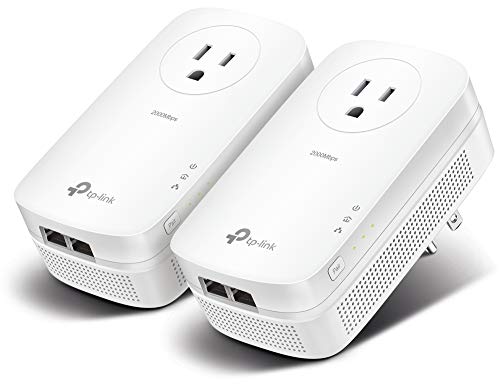
TP-Link TL-PA9020P KITAn AV2000 powerline kit with two Gigabit ports per adapter. Not as fast or as predictable as coax, and still a wire — which beats a weak 2.4 GHz link to a console that cannot move.
TP-Link Archer BE550Tri-band Wi-Fi 7 with 2.5 Gbps ports and measured throughput well over a gigabit on 6 GHz at close range. Worth it only if your wired speed test also comes back slow — otherwise you are replacing the part that works.
Prices as of October 17, 2026, read from each product's own Amazon listing; Amazon prices change often. Scroll the table sideways on a narrow screen. Scores are our editorial assessment from published specifications and independent testing by named outlets — not our own lab results. What we do and do not test.
The picks in full
#1 · A console in a room with a coax outlet
ScreenBeam ECB6200K02
ScreenBeam · Budget tier
Bonded MoCA 2.0 tops out near 1 Gbps, which is everything you need on a gigabit-or-slower plan, for less money than MoCA 2.5.
Key specifications
Standard
Bonded MoCA 2.0
Ceiling
About 1 Gbps
Honest fit
Plans at 1 Gbps or below
Score 9.1/10
Speed gained9.0
Latency9.5
Install effort9.0
Value9.0
What it gets right
+Cheaper than MoCA 2.5 and indistinguishable from it on a gigabit plan
+Same shielded-coax advantage over powerline
What to watch for
−Caps out around 1 Gbps, so a multi-gig plan will outgrow it
−Not worth buying if you expect to upgrade your plan soon
#ad Price as of October 17, 2026; Amazon prices change often. How we are funded.
Common questions
Why is my PS5 Wi-Fi slower than my phone?+−
Because the console does not move, sits low in a cabinet behind a TV, and usually picked its band once and kept it. A phone re-chooses the best band every time it reconnects and is held in open air. Same network, very different conditions.
Should my PS5 use 2.4 GHz or 5 GHz?+−
5 GHz, unless the console is genuinely out of its range. Check under Settings, Network, Connection Status. If both bands share one network name and the console chose 2.4 GHz, splitting the names and joining the 5 GHz one directly is the reliable fix.
Will Ethernet make my PS5 download faster?+−
Almost always, and it also removes the lag spikes and packet loss that Wi-Fi causes in online play. If you cannot run a cable, a MoCA pair over existing TV coax or a powerline kit gives you the same wired link without opening a wall.
Why is my PS5 download slow but my speed test is fast?+−
A speed test is a ten-second burst and a game download is twenty minutes of sustained transfer, so a marginal link passes the first and fails the second. It can also be the content delivery network rather than your house — pausing and resuming the download sometimes moves you to a faster server.