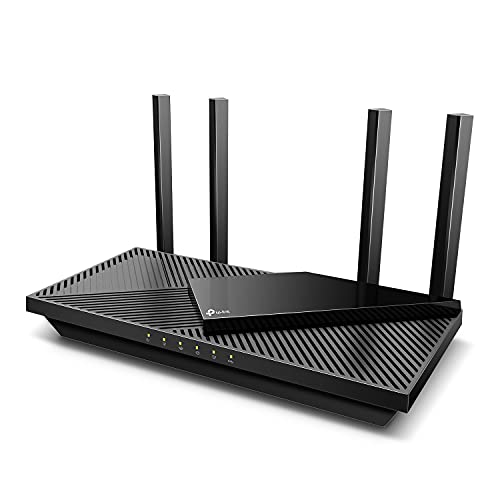
One router can cover three floors — but only from the middle one, and only up to a point. Here is the hardware that gets closest, and the test that tells you to stop buying routers.
How this page is funded: some links here are affiliate links, and Mesh & Signal earns a commission if you buy through them. It costs you nothing extra, it never changes which product we rank first, and we do not publish a price we have not verified. Full disclosure.
Buy the Netgear Nighthawk RS700S if you want the most coverage a single router can give three floors, and the ASUS RT-BE86U if you would rather start with one box and keep the option of adding a second. Both of those are only the right purchase if the router can live on the middle floor. If it is stuck in a basement corner next to the service entry, no router in this list — or any other — will reach the top floor properly, and the money belongs somewhere else.
Why three floors is a different problem from a big footprint
A router radiates outward and slightly downward, not in a neat sphere. Horizontal distance across an open floor costs you comparatively little. Vertical distance costs you a floor assembly each time: joists, subfloor, flooring, and frequently a layer of ductwork or foil-backed insulation running between them. Two of those in a row is the thing that kills a single-router three-story install, and it is why a router rated for 3,500 sq ft can cover a 3,500 sq ft ranch and fail in a 2,400 sq ft townhouse stacked three high.
That is also why floor placement beats every spec on the box. From the middle floor a router has one floor assembly to punch through in each direction. From the ground floor it has two to reach the top, and the second one is where 5 GHz gives up.
Router sits on
Same floor
One floor away
Two floors away
Middle floor
Full plan speed on 5 GHz
Usable 5 GHz, most of the plan
n/a — there is no second floor away
Ground floor
Full plan speed on 5 GHz
Usable 5 GHz
2.4 GHz only, often under 50 Mbps
Basement
Full plan speed
Usable on the ground floor
Frequently no usable signal at all
What one well-placed router realistically delivers on each floor.
Scroll the table sideways to see every column.
The ten-minute test that decides whether to buy a router at all
Before you spend anything, stand in the worst room on the top floor with a phone and run a speed test, then do the same standing next to the router. Our room-by-room speed test method has the full procedure. The result tells you which purchase you are making:
Top floor gets more than half the speed you get next to the router. A better router on the middle floor will finish the job. Buy from this page.
Top floor gets a weak but stable connection, under a third of the speed. One box is on the edge. Buy a router with a mesh path — the RT-BE86U here — and plan on adding a node.
Top floor drops the connection or shows no bars. Stop. No router fixes this. Wi-Fi for a three-story house is the page you want, and the answer in it is a second radio on the top floor.
What actually helps vertically
Antenna design and transmit behavior, not antenna count. Beamforming steers signal toward the client; six antennas pointed at the ceiling do not. Published coverage figures from a lab that measured them are worth more than the number of sticks.
A strong 2.4 GHz radio. It is the band that survives two floor assemblies. A router that treats 2.4 GHz as an afterthought will look fine in reviews and be useless on your top floor.
Multi-gig LAN ports. Not for speed — for the day you run a cable to the top floor and put an access point on the end of it. That is the configuration that always works, and the router needs a port worth plugging into.
A mesh path from the same vendor. AiMesh, OneMesh and EasyMesh let you add a node without starting over.
This usually backfires
Do not buy a bigger router for a basement-mounted box
If your router lives in the basement because that is where the coax or fiber enters, the problem is the location and not the hardware. Relocating the router is usually possible — a longer coax run, a MoCA link, or simply moving the modem — and it is free or nearly free compared with a flagship router that will still be in the basement. Where to put your router walks through the options.
Where the money is better spent
On three floors there is one configuration that beats every router on this page: a cable to the top floor and an access point on the end of it. It costs less than a flagship router, it does not degrade, and it leaves the existing router doing the two floors it can already handle. Using a real access point at home covers what that install involves, and ethernet backhaul for mesh is the same idea with a mesh system instead of an AP.
If running a cable is genuinely impossible, coax is the next best wire — MoCA adapters turn the TV coax most three-story houses already have on every floor into a network link. The comparison pages that settle the rest of this decision are mesh versus a router and best Wi-Fi router for a large home, which covers the footprint version of the same limit.
How we picked
We do not run a test lab. Rankings here are built from the manufacturers' published specifications, measurements taken by independent outlets that do have labs, and the structural reasoning on this site about what a given house or job actually needs. Every product was checked as currently sold before it was included. Where a figure appears it is attributed and linked in Sources; where we have no basis for a claim, it is left out. Our methodology sets out exactly what we will and will not assert.
Quick picks
Ranked by our published scoring rubric (vertical reach, wired ports, expansion path, value). Tap any row to jump to the full write-up, or go straight to the retailer from the right-hand column. How we score.
#
Product
Best for
Score
Price
1
Netgear Nighthawk RS700SThe Nighthawk RS700S held the most consistent coverage across a 3,500 sq ft home in independent testing, which is the single number that matters when the floor above and the floor below are both asking the radio for signal. Buy it if you want to try one router before you try three.
ASUS RT-BE86UWi-Fi 7, roughly 30% more processing than the RT-AX86U Pro it replaced, and AiMesh — so the day the top floor proves one box short, you add an ASUS node instead of replacing the router. On a three-floor house that escape hatch is worth more than a spec bump.
TP-Link Archer BE550 ProA 10 Gbps WAN/LAN port and four 2.5 Gbps LAN ports. On three floors the ports matter as much as the radio, because the honest fix for the far floor is a cable — and this is the router you want on the other end of it.
TP-Link Archer AX55AX3000 Wi-Fi 6 that measured 823.7 Mbps at 15 ft and stayed usable at 70 ft in TechGearLab testing. On a plan under about 500 Mbps in a narrow three-story townhouse, spending more buys you very little that you will notice.
Prices as of October 17, 2026, read from each product's own Amazon listing; Amazon prices change often. Scroll the table sideways on a narrow screen. Scores are our editorial assessment from published specifications and independent testing by named outlets — not our own lab results. What we do and do not test.
The picks in full
#1 · The most reach available from one box
Netgear Nighthawk RS700S
Netgear · Premium
The single-box range champion in independent testing: the most consistent coverage across a 3,500 sq ft home of the routers tested against it.
Key specifications
Standard
Wi-Fi 7
Measured strength
Most consistent coverage at 3,500 sq ft in real-world testing
Best suited to
Large single-router homes and long floor plans
Score 8.6/10
Vertical reach9.5
Wired ports8.0
Expansion path6.0
Value7.0
What it gets right
+Range consistency rather than peak speed is what it was measured best at, and consistency is what a far bedroom actually needs
+Enough wired headroom for a multi-gig plan
+Covers a large footprint from one box, which avoids adding a relayed hop at all
What to watch for
−Expensive for a single router, and a two-node mesh at the same money will beat it in a house with masonry
#ad Price as of October 17, 2026; Amazon prices change often. How we are funded.
Common questions
Can one router cover a 3-story house?+−
Sometimes — if it sits on the middle floor and the house is not unusually wide. From the middle floor the radio has one floor assembly to cross in each direction, which a strong router handles. From the ground floor or a basement it has two to reach the top, and that is the configuration that fails.
Which floor should the router go on in a 3-story house?+−
The middle one, as centrally as the cabling allows, out in the open and off the floor. That single decision does more for top-floor coverage than any upgrade on this page, and it is the first thing to try before spending money.
Is mesh better than one router for three floors?+−
Usually, yes — a radio per floor beats one radio shouting through two floor assemblies. The exception is a narrow townhouse where the middle floor is genuinely central: there, one good router plus a wired access point on the top floor often outperforms a three-pack mesh on wireless backhaul.
Will a Wi-Fi 7 router reach further than my old one?+−
Not meaningfully, on range alone. Wi-Fi 7 improves congestion handling and throughput, and its 6 GHz band is the worst of the three at crossing floors. What a new flagship does give you is a better 2.4 GHz implementation and better beamforming, which is a real but modest gain.