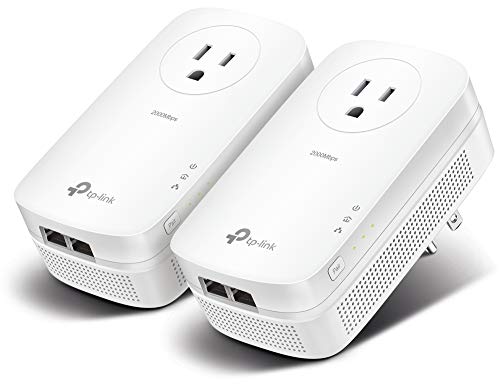
Same price, same shelf, opposite failure modes. One is defeated by your house wiring and the other by your walls — so the right answer is whichever one your house does not defeat.
How this page is funded: some links here are affiliate links, and Mesh & Signal earns a commission if you buy through them. It costs you nothing extra, it never changes which product we rank first, and we do not publish a price we have not verified. Full disclosure.
Buy a powerline kit if the device in the far room has an Ethernet port, and a Wi-Fi extender if it does not and the room still gets a usable signal. That one sentence resolves most of this comparison, because the two products fail in completely different places: powerline is defeated by your electrical wiring, an extender is defeated by your walls, and your house has already decided which of those is worse.
How each one actually works
A powerline adapter is a pair. One plugs in near the router and takes an Ethernet cable from it; the other plugs in near the far room and gives you an Ethernet port there. The data travels on your mains wiring. Nothing is broadcast, so no Wi-Fi is involved until you plug something into the far end.
A Wi-Fi extender is a single unit that listens to your router's signal and rebroadcasts it. No wiring, no cables, and no new capacity — it is passing the same airtime along twice. Do Wi-Fi extenders slow down your internet covers that cost properly.
Powerline
Wi-Fi extender
What it delivers at the far end
An Ethernet port
A Wi-Fi signal
Depends on
Your electrical wiring
How much signal reaches it
Typical real-world result
200-600 Mbps on decent wiring
A third to a half of the router's speed
Latency added
Low and steady
Variable, worse at distance
Works where there is almost no signal
Yes
No
Covers a room for phones
Only with a second radio
Yes, that is the point
Killed by
Different circuits, GFCI, old wiring
Thick walls, distance, interference
The trade, stated plainly.
Scroll the table sideways to see every column.
The test that decides it in five minutes
Stand halfway between the router and the problem room and run a speed test on your phone.
Strong there (more than half your plan): an extender placed at that exact spot will work well, and it is the cheaper, simpler purchase.
Weak there: an extender has nothing good to rebroadcast. Go powerline, or go wired.
Weak there and the far room is a bedroom full of phones: powerline plus a cheap access point or an old router in AP mode. That combination is the one most people miss and it beats both products on this page.
This usually backfires
Do not judge powerline by the number on the box
AV1000 and AV2000 are theoretical PHY rates for the powerline link, not throughput you will see. Real results depend on circuit layout, run length and what else is plugged in. The honest expectation on normal modern wiring is a few hundred Mbps — which is still far more than a weak Wi-Fi signal delivers.
What makes powerline fail
The two sockets are on different phases of the panel. The signal has to cross at the panel and loses a lot doing it. G.hn adapters handle this better than HomePlug AV2 ones.
A GFCI or AFCI breaker in the path, or a surge protector between the adapter and the wall. Always plug into the wall directly; use the adapter's own passthrough socket for the thing you displaced.
Old or aluminum wiring, and long runs. A pre-1970s house is where powerline most often disappoints.
What makes an extender fail
Being placed in the problem room. The commonest mistake, and it produces full bars on a bad connection.
A single-band unit. It halves throughput by design. Dual-band minimum.
Devices clinging to the far router. Without EasyMesh, OneMesh or a vendor-matched pair, your phone will hold the weak original signal rather than switch.
If neither answer appeals, the two better wires are coax — MoCA versus powerline — and a proper cable run. And if the whole house rather than one room is the problem, this is the wrong comparison entirely: powerline versus mesh and mesh versus an extender are the ones that size the purchase correctly.
How we picked
We do not run a test lab. Rankings here are built from the manufacturers' published specifications, measurements taken by independent outlets that do have labs, and the structural reasoning on this site about what a given house or job actually needs. Every product was checked as currently sold before it was included. Where a figure appears it is attributed and linked in Sources; where we have no basis for a claim, it is left out. Our methodology sets out exactly what we will and will not assert.
Quick picks
Ranked by our published scoring rubric (speed at the far end, consistency, setup, value). Tap any row to jump to the full write-up, or go straight to the retailer from the right-hand column. How we score.
#
Product
Best for
Score
Price
1
TP-Link TL-PA9020P KITAn AV2000 kit with two Gigabit ports per adapter and a passthrough socket. If the device at the far end has an Ethernet port, this beats any extender, because what arrives is a wire rather than half a weak signal.
TP-Link RE715XAX3000 with a Gigabit port and EasyMesh roaming. The right buy when the problem room still gets a usable signal and the devices in it are wireless-only — where a powerline adapter would need a second radio bolted on anyway.
Phones and tablets in a room that is nearly covered
Comtrend PG-9172ACG.hn rather than HomePlug AV2, rated up to 1.2 Gbps and notably more tolerant of older wiring and cross-phase runs — the two conditions that make ordinary powerline kits disappoint. Try this before concluding powerline does not work in your house.
TP-Link RE315AC1200 covering a claimed 1,600 sq ft and 32 devices. Honest about what it is: enough for a phone and a tablet in a spare room, not enough for gaming or a 4K TV. The cheapest thing on this page that is not a waste of money.
Prices as of October 17, 2026, read from each product's own Amazon listing; Amazon prices change often. Scroll the table sideways on a narrow screen. Scores are our editorial assessment from published specifications and independent testing by named outlets — not our own lab results. What we do and do not test.
The picks in full
#1 · The far room has a desk, a console or a TV
TP-Link TL-PA9020P KIT
TP-Link · Midrange
The powerline kit to buy: AV2000 rated, a passthrough plug so you do not lose the socket, and two gigabit ports on each end.
Key specifications
Rating
AV2000, up to 2 Gbps rated
Ports
2 Gigabit Ethernet per adapter
Plug
Passthrough AC socket
Real-world
Depends entirely on your house wiring
Score 8.6/10
Speed at the far end8.5
Consistency8.0
Setup9.5
Value8.5
What it gets right
+Two Ethernet ports per end means one run can feed a console and a TV
+Passthrough plug keeps the outlet usable, which matters more than it sounds
+Works where Wi-Fi genuinely cannot — a detached garage on the same panel, for example
What to watch for
−The rated speed is a laboratory number; your electrical wiring sets the real one
−Adapters on different circuit breaker phases can lose most of their throughput
−Surge protectors and some appliances will interfere with it
#ad Price as of October 17, 2026; Amazon prices change often. How we are funded.
#2 · Phones and tablets in a room that is nearly covered
TP-Link RE715X
TP-Link · Midrange
The extender to buy if you are buying an extender: AX3000 speeds, a gigabit Ethernet port, and EasyMesh so it behaves like a node rather than a second network.
Key specifications
Standard
Wi-Fi 6, AX3000
Coverage claim
About 2,400 sq ft
Ports
1 Gigabit Ethernet
Roaming
EasyMesh compatible
Score 8.3/10
Speed at the far end7.5
Consistency7.5
Setup9.5
Value9.0
What it gets right
+EasyMesh support means one network name and real handoff, instead of a second SSID you have to switch to manually
+The gigabit port turns it into an access point if you can run a cable to it
+AX3000 leaves enough headroom that the halved wireless throughput is still usable
What to watch for
−EasyMesh only works if your router supports it — check before you buy
−Wireless mode still splits its radio between router and device
−Costs enough that a budget mesh three-pack becomes a fair comparison
#ad Price as of October 17, 2026; Amazon prices change often. How we are funded.
Common questions
Is a powerline adapter better than a Wi-Fi extender?+−
For a device with an Ethernet port in a room with weak signal, yes — clearly. For phones and tablets in a room that still receives a decent signal, no, because an extender covers the room and a powerline adapter only reaches the socket. Match the product to what is in the room.
Can I use a powerline adapter and an extender together?+−
Yes, and it is one of the best cheap setups there is: run powerline to the far room, then plug an access point, a spare router in AP mode or an extender with an Ethernet port into the far adapter. The radio at the far end is now fed by a wire, so none of the usual halving applies.
Do powerline adapters work in old houses?+−
Sometimes, and less predictably than in newer ones. Old wiring, long runs and circuits split across phases all cost throughput. G.hn adapters are the more tolerant technology for exactly this case, and they are the right thing to try before concluding powerline is a dead end in your house.
Which is better for gaming, powerline or an extender?+−
Powerline, by a wide margin. A console cares about jitter and packet loss more than peak bandwidth, and a powerline link is steady in a way a rebroadcast Wi-Fi signal is not. A MoCA link over coax is better still if your house has it.