This is not a coincidence or a superstition. A microwave oven is a 1,000-watt transmitter sitting in the middle of the 2.4 GHz Wi-Fi band — and your router runs at about a tenth of a watt.
How this page is funded: some links here are affiliate links, and Mesh & Signal earns a commission if you buy through them. It costs you nothing extra, it never changes which product we rank first, and we do not publish a price we have not verified. Full disclosure.
A microwave oven heats food using radio energy at about 2.45 GHz, which sits in the middle of the 2.4 GHz Wi-Fi band. Enough of it leaks past the door seal to overwhelm a router transmitting at roughly a tenth of a watt — so the fix is to get your devices onto 5 GHz, where the oven cannot reach them.
Why this happens at all, when the oven is shielded
A microwave is shielded — the mesh in the door and the metal cavity are there to contain the energy, and a working oven keeps leakage within safety limits. But the limits that keep you safe are enormously higher than the signal levels Wi-Fi works with. A router transmits at around 100 milliwatts. A microwave generates around 1,000 watts. Leakage measured in milliwatts is harmless to you and catastrophic to a 2.4 GHz link a few meters away.
Two details make it worse in practice. Older ovens leak more as the door seal and hinge wear, so this problem commonly appears years into an oven's life. And a microwave does not transmit continuously — most cycle their magnetron on and off, which produces bursts of interference rather than a steady wall. Bursts are harder for a Wi-Fi link to cope with than constant noise, because every burst triggers retransmissions.
Confirm it in two minutes
Start a video call, a stream or a continuous ping on a device.
Put a mug of water in the microwave and run it for a minute.
Watch whether the connection degrades the moment it starts and recovers the moment it stops.
Repeat on a device you know is on 5 GHz. If that one is unaffected, you have both the diagnosis and the fix.
Band
Overlaps the oven
Typical devices on it
2.4 GHz
Yes — directly
Smart plugs, older TVs, printers, anything far from the router
5 GHz
No
Phones, laptops and tablets in range
6 GHz
No
Recent phones and laptops on Wi-Fi 6E or 7
Which of your devices will be affected.
Scroll the table sideways to see every column.
The three fixes
Free: move the devices, or the router, off the kitchen axis. Interference falls off quickly with distance. If the router sits on a kitchen counter or on the other side of the kitchen wall, relocating it a room away is often the entire fix — where to put your router covers what else that improves.
Free: change your 2.4 GHz channel. Microwave leakage is strongest in the upper part of the band, so moving your 2.4 GHz network to channel 1 rather than 6 or 11 measurably helps. It is a setting in every router's admin page, and Wi-Fi interference from neighbors and devices explains how to pick one that is not also crowded.
Permanent: get the affected devices onto 5 GHz. Nothing on 5 or 6 GHz is affected by a microwave at all. If devices in that part of the house have fallen back to 2.4 GHz, it is because 5 GHz does not reach there — which means the real fix is a radio nearer the kitchen, not a better 2.4 GHz channel.
Worth knowing
A 2.4 GHz-only device cannot be moved
Plenty of smart plugs, older thermostats and cheap cameras are 2.4 GHz only and always will be. For those the answer is distance and channel choice rather than a band change — and if one of them is critical, moving it or the oven a few feet apart is a legitimate fix. Smart home Wi-Fi covers how to plan around a 2.4 GHz-only fleet.
When it is not the microwave
Other things in a kitchen sit on or near 2.4 GHz: cordless phone bases, some baby monitors, Bluetooth speakers and, less often, badly shielded LED drivers and induction hobs. If the drops correlate with the kitchen being busy rather than with the oven specifically, work through the interference guide instead.
Almost never for this reason alone — an oven leaking enough to disrupt Wi-Fi is still, in the overwhelming majority of cases, within safety limits. But a noticeably worse problem than last year, especially alongside a door that no longer closes cleanly, is worth having looked at on its own merits. Fix the Wi-Fi with the band change either way; it is faster and it works regardless.
How we picked
We do not run a test lab. Rankings here are built from the manufacturers' published specifications, measurements taken by independent outlets that do have labs, and the structural reasoning on this site about what a given house or job actually needs. Every product was checked as currently sold before it was included. Where a figure appears it is attributed and linked in Sources; where we have no basis for a claim, it is left out. Our methodology sets out exactly what we will and will not assert.
Quick picks
Ranked by our published scoring rubric (solves it, kitchen coverage, install effort, value). Tap any row to jump to the full write-up, or go straight to the retailer from the right-hand column. How we score.
#
Product
Best for
Score
Price
1
TP-Link Archer BE550Tri-band Wi-Fi 7 with 5 GHz and 6 GHz available, both of which a microwave cannot touch. If most of your devices are stuck on 2.4 GHz because the router is old or far away, this is the upgrade that makes the question disappear.
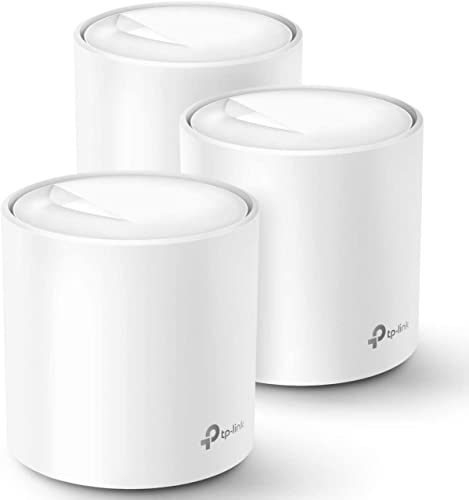
TP-Link Deco X20A budget Wi-Fi 6 mesh covering up to about 5,800 sq ft. The point is not the headline number — it is putting a 5 GHz radio on the far side of the kitchen, so the devices there stop falling back to the band the oven is jamming.
TP-Link RE700XAX3000 in the same class as the RE715X. Placed on the far side of the kitchen it gives the affected room a strong 5 GHz signal of its own, which is the cheapest way to stop a single room falling back to 2.4 GHz.
Prices as of October 17, 2026, read from each product's own Amazon listing; Amazon prices change often. Scroll the table sideways on a narrow screen. Scores are our editorial assessment from published specifications and independent testing by named outlets — not our own lab results. What we do and do not test.
The picks in full
#1 · Getting the whole house off 2.4 GHz
TP-Link Archer BE550
TP-Link · Midrange
The most future-proof router for the money: full Wi-Fi 7 with multi-link operation, 320 MHz channels and 4K-QAM, plus 2.5 Gbps ports throughout.
Key specifications
Standard
Wi-Fi 7, tri-band (includes 6 GHz)
Features
Multi-link operation, 320 MHz channels, 4K-QAM
Measured
Over 3 Gbps on 6 GHz at close range in testing
Wired
2.5 Gbps ports; full gigabit-plus over wired in testing
Score 8.5/10
Solves it9.0
Kitchen coverage8.0
Install effort9.0
Value8.0
What it gets right
+Gets you the genuinely useful Wi-Fi 7 features — multi-link operation and 320 MHz channels — rather than the badge on dual-band hardware
+2.5 Gbps ports mean it will not cap a fiber or multi-gig cable plan
+Independent testing measured over 3 Gbps on the 6 GHz band at close range
+Vertical tower design takes less shelf space than the antenna-covered alternatives
What to watch for
−6 GHz range is short, so the headline number only applies within a room or two
#ad Price as of October 17, 2026; Amazon prices change often. How we are funded.
Common questions
Why does my Wi-Fi cut out when the microwave is on?+−
Microwave ovens heat food at about 2.45 GHz, which sits inside the 2.4 GHz Wi-Fi band. The small amount that leaks past the door seal is harmless to people and far stronger than your router's signal, so devices on 2.4 GHz lose their connection while the oven runs.
Does a microwave affect 5 GHz Wi-Fi?+−
No. Microwave ovens operate around 2.45 GHz and have no effect on the 5 GHz or 6 GHz bands. Moving the affected devices to 5 GHz is the most reliable fix available, and it costs nothing if the signal reaches.
Does a leaking microwave mean it is dangerous?+−
Not by itself. The leakage limits that protect people are far higher than the levels that disrupt Wi-Fi, so an oven can interfere badly and still be well within spec. A door that no longer seals cleanly is worth getting checked on its own merits, but Wi-Fi trouble alone is not evidence of a safety problem.
Which 2.4 GHz channel is least affected by a microwave?+−
Channel 1 is generally the best choice, because microwave leakage tends to be strongest toward the upper end of the band where channels 6 and 11 sit. Pick between the non-overlapping channels on how crowded each one is in your building as well.