A gradual decline and an overnight collapse are different problems with different answers. If yours changed suddenly, something specific changed with it — and the list is shorter than you think.
How this page is funded: some links here are affiliate links, and Mesh & Signal earns a commission if you buy through them. It costs you nothing extra, it never changes which product we rank first, and we do not publish a price we have not verified. Full disclosure.
A sudden slowdown is a change, so look for the change. In order of how often it turns out to be the answer: something new joined the network, your provider's local segment got busier, a firmware or OS update landed, a neighbor installed a new router, or a piece of your own hardware started to fail.
That ordering matters. The general diagnostic page on this site, why is my Wi-Fi so slow, works forwards from the symptom and is the right page for a network that has never been good. This one works backwards from a date, which is much faster when the network used to be fine.
Step 1: narrow it to one of three places
Run a speed test on a device plugged into the router with a cable, then the same test on a phone standing next to the router, then again in the room where you noticed the problem.
Wired
Phone at router
Phone in the room
What changed
Slow
Slow
Slow
Your internet connection or the modem
Fast
Slow
Slow
The router, or the airwaves around it
Fast
Fast
Slow
Coverage — something changed in the house
Fast
Fast
Fast
One device, or one app or service
Three tests, five minutes, and the cause is in one box.
Something new joined. A new TV, a games console mid-download, a security camera uploading continuously, a laptop running cloud backup. One new device doing sustained upload can flatten a household — check your router's device list.
An update landed. Router firmware, a phone OS update, a Windows driver update. If the date lines up with an update, that is your suspect; the laptop-specific version covers the driver case.
A neighbor changed something. A new router next door on your channel, or a new mesh system filling the building with traffic. This is the most common cause in apartments and it shows up overnight — the interference guide has the channel fix.
The house changed. A new desk in a far room, a rearranged living room, a metal shelving unit, a new fish tank. Signal paths are more fragile than they feel.
Your plan or provider changed. A promotional rate ending, a plan migration, or local congestion from new customers on the same segment — worth a call, and it is free to ask.
Something is failing. A modem with rising error counts, a router that needs weekly reboots, a chewed or crushed Ethernet cable. This is last on the list because it is less common than the five above, not because it is unlikely.
Try this first
Reboot properly, once, and note whether it helps
Power off the modem and the router, wait thirty seconds, power the modem up first and let it fully sync before the router. If that fixes it for a day and the problem returns, that pattern is itself the diagnosis: something is accumulating state and failing, and it is time to replace the box that recovers when rebooted.
Replace the modem if your provider's diagnostics show rising error counts, or if a wired speed test is well below your plan and the line itself tests clean. Replace the router if it needs regular reboots, if it has stopped receiving firmware updates, or if it predates Wi-Fi 6 and your household has grown — how often to replace your router sets out the useful thresholds. Add radios, rather than replacing the router, when the only slow place is a room.
How we picked
We do not run a test lab. Rankings here are built from the manufacturers' published specifications, measurements taken by independent outlets that do have labs, and the structural reasoning on this site about what a given house or job actually needs. Every product was checked as currently sold before it was included. Where a figure appears it is attributed and linked in Sources; where we have no basis for a claim, it is left out. Our methodology sets out exactly what we will and will not assert.
Quick picks
Ranked by our published scoring rubric (fixes sudden drops, diagnosis, install effort, value). Tap any row to jump to the full write-up, or go straight to the retailer from the right-hand column. How we score.
#
Product
Best for
Score
Price
1
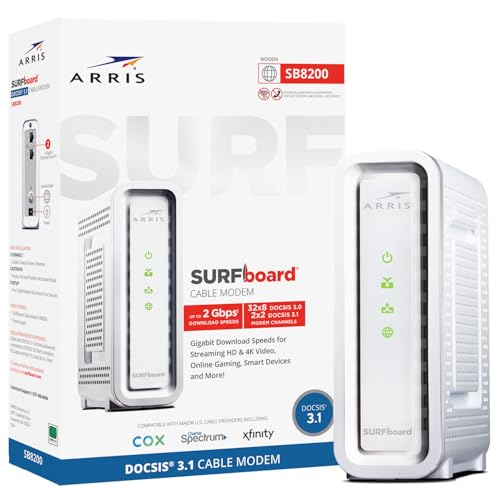
ARRIS SURFboard SB8200A DOCSIS 3.1 modem, the component most likely to be quietly failing when speed drops suddenly on a cable connection and stays dropped. Swapping it also ends the rental fee, which is the only upgrade on this site that pays for itself.
ASUS RT-BE86UWi-Fi 7 with ASUS's full feature set and no subscription, plus AiMesh to add nodes later. The replacement to reach for when a router needs weekly reboots to stay fast — that pattern does not get better.
TP-Link Deco BE23Entry-tier Wi-Fi 7 mesh at TP-Link's price-performance point. The right answer when the slowdown traces to a new room, a new wall or a new work-from-home desk rather than to a fault — the hardware did not break, the house got bigger.
Prices as of October 17, 2026, read from each product's own Amazon listing; Amazon prices change often. Scroll the table sideways on a narrow screen. Scores are our editorial assessment from published specifications and independent testing by named outlets — not our own lab results. What we do and do not test.
The picks in full
#1 · A cable connection that has degraded
ARRIS SURFboard SB8200
ARRIS · Midrange
The safe DOCSIS 3.1 modem: on the approved list for Xfinity, Spectrum and Cox, with a two-year warranty behind it.
Key specifications
Standard
DOCSIS 3.1
Ports
2 Gigabit Ethernet
Approved by
Xfinity, Spectrum and Cox
Warranty
2 years
Score 8.8/10
Fixes sudden drops9.0
Diagnosis8.5
Install effort8.5
Value9.0
What it gets right
+Being on all three major approved lists means it survives a change of provider
+DOCSIS 3.1 is the floor now that cable operators are retiring 3.0 hardware
+A two-year warranty is unusual in this category
What to watch for
−Gigabit Ethernet only — a multi-gig plan needs a 2.5 Gbps port instead
−It is a modem, not a router: you still need Wi-Fi from somewhere
#ad Price as of October 17, 2026; Amazon prices change often. How we are funded.
Common questions
Why did my Wi-Fi suddenly get slow?+−
Something changed, and the usual candidates are a new device doing sustained uploads or downloads, a firmware or OS update, a neighbor moving onto your channel, furniture or a desk moving, or a modem starting to fail. Run a wired speed test first to narrow it to the connection, the router or coverage.
Can a neighbor's new router slow my Wi-Fi overnight?+−
Yes, and in an apartment building it is one of the most common causes of an overnight change. A new network on your channel shares the same airtime. Changing your channel, or moving devices to 5 GHz or 6 GHz where there is far more room, usually resolves it.
Does rebooting the router fix a sudden slowdown?+−
Often temporarily, which is useful information. If a reboot restores full speed and the problem comes back within days, the router or modem is accumulating state and failing, and replacing it is the real fix rather than rebooting on a schedule.
How do I tell if the slowdown is my ISP or my Wi-Fi?+−
Plug a computer directly into the router with an Ethernet cable and run a speed test. If the wired result is also slow, the problem is your connection or your modem and Wi-Fi is innocent. If the wired result matches your plan, everything after the router is where to look.